
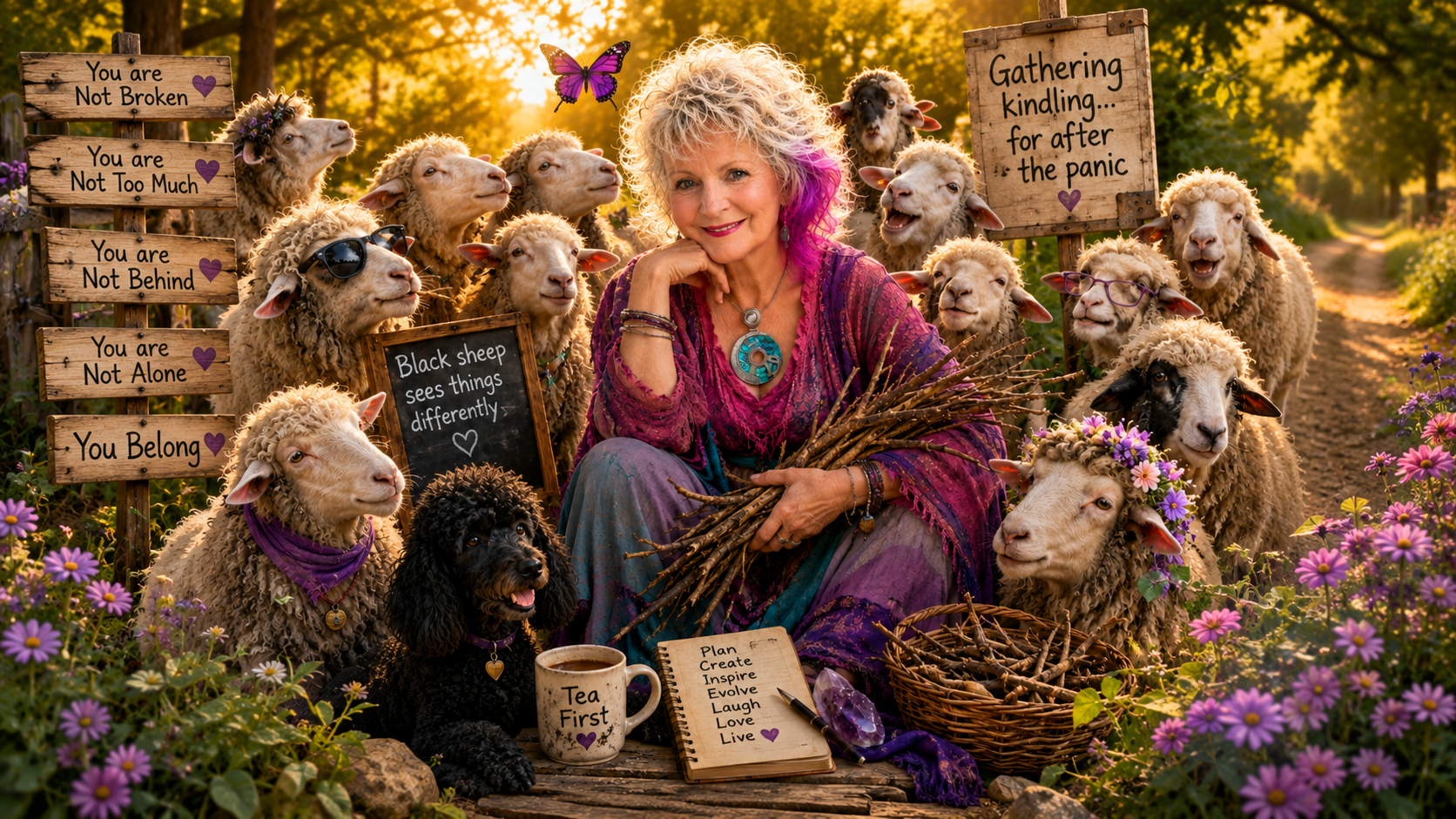
I have spent much of my life wondering whether I was simply not very good at being human.
I can be warm. I can be social. I talk to strangers on buses and ferries. I smile at checkout staff because they spend their days as standing targets for everyone else’s irritation. I can join a pottery group, a craft group, a spiritual group or a professional group and genuinely enjoy the people in it.
But I never really become part of the group.
I move in.
I move out.
I connect with people, but I do not seem to develop the identity of belonging that other people appear to take for granted.
The same has often been true of family.
And relationships.
For years, I presumed this meant there was something missing in me.
Recently, I began listening to a book about a concept called the otrovert: a person who may be perfectly capable of connection but does not naturally derive identity from belonging to a group.
My first response was recognition.
My second was irritation.
Because the author began describing the characteristics of people who do not identify with groups and then essentially said, “You will know if you are one of this group.”
My mind immediately replied:
Stop trying to put me into a group.
There may be no more convincing evidence that the description fits me.
But beneath the humour, something much bigger began to happen.
For perhaps the first time in my life, I had a reference point.
Over the years, people have told me in various ways that I am not broken. I have even told myself that.
But there was always an unanswered question underneath it.
But based on what?
If I was not broken, why did I seem to experience belonging, family, intimacy and relationships so differently from the people around me?
Why did things that were supposed to feel loving sometimes feel like pressure?
Why did holding hands while walking feel less like romance and more like being forced into someone else’s rhythm?
Why did another person’s need for agreement make me want to run in the opposite direction?
Why did “we” so often feel as though it came at the expense of “me”?
Without another framework, the only one available was the dominant one.
And according to that model, I was not doing it properly.
When Connection Comes With a Hidden Invoice
I have realised that I do not dislike intimacy.
I dislike the demand that is sometimes hidden underneath it.
Prove you love me.
Hold my hand.
Agree with me.
Want what I want.
Do this with me.
Feel what I feel.
Move at my pace.
Reassure me that we are a “we.”
For many people, these things may be natural expressions of closeness. But for me, the moment affection carries an unspoken requirement to prove something, it stops feeling clean.
It comes with a cost.
And yet I know I am capable of receiving deeply.
A genuinely caring massage is a perfect example.
The rules of engagement are clear. I have paid. The person is good at what they do and has nothing to prove. They are not touching me because they need reassurance from me. They are not waiting for me to give something back. They allow themselves to give, and I can receive fully.
That distinction taught me something important.
No “prove you love me” underneath.
Then connection becomes clean.
Without pressure.
Chosen.
Perhaps I was never incapable of intimacy.
Perhaps I was simply highly resistant to intimacy being used as evidence.
When Feelings Become Household Weather
This has also helped me understand something I have struggled with in relationships.
In many households, one person’s feelings become the weather.
Their anxiety becomes the atmosphere everyone else must live inside.
Their mood changes the day’s plans.
Their internal world becomes the reference point around which everyone else must organise.
This does not necessarily mean they are cruel.
They may care very deeply.
Internally.
But care that remains inside a person does not necessarily become consideration.
It does not automatically become timing.
Responsibility.
Reciprocity.
Or action.
Someone can genuinely care about you and still consistently fail to factor you into their decisions.
And then, when you object, the conversation may become about their feelings.
They feel criticised.
They feel rejected.
They feel that they can never win.
Once again, their feelings become the household weather.
Everyone is now discussing the storm instead of asking why the roof was never fixed.
This pattern is not confined to relationships.
I see it in spirituality too.
Why Is All the Responsibility on the Person Beside the Road?
There is a form of spiritual bypass that has bothered me for years.
When someone is struggling, we have an extraordinary number of explanations for why it is their responsibility.
Perhaps it is their karma.
Perhaps they manifested it.
Perhaps they have not done enough inner work.
Perhaps they are stuck in victimhood.
Perhaps they are lazy.
Perhaps they need to raise their vibration.
Perhaps their soul chose the experience.
Perhaps they simply need to take responsibility.
Maybe.
But I keep coming back to the old story of the injured person beside the road.
Two respectable people see him and walk past.
Another person stops.
And I find myself wondering why so much modern spiritual thinking is obsessed with asking:
Why were they on the road?
What did they do?
What did they attract?
What lesson was their soul learning?
Why were they not taking responsibility for getting themselves up?
And so little of it asks:
Why did you walk past?
We have created entire philosophies explaining why the suffering person is responsible for their suffering while giving remarkably little attention to the responsibility of the person who sees them and chooses not to help.
The person in distress must heal.
The traumatised person must do the work.
The poor person must try harder.
The lonely person must learn to love themselves.
The wife must understand her husband’s anxiety.
The person affected by someone else’s behaviour must regulate their response.
The person lying beside the road must apparently conduct a complete spiritual audit of how they got there.
Meanwhile, the person walking past can simply say:
I care.
And apparently that is enough.
I don’t think it is.
Care Is Not a Thought
This is one of the strongest beliefs I hold.
Care that never becomes action may be a genuine feeling, but it is not necessarily useful to the person being cared about.
Love that exists only inside you does not automatically reach another person.
Good intentions do not rearrange appointments.
Concern does not make the phone call.
Caring does not become care until, somewhere along the line, it enters the physical world.
This does not mean we must rescue everyone.
It does not mean every suffering person becomes our responsibility.
It does not mean we abandon boundaries, sovereignty or personal responsibility.
But neither does personal responsibility absolve us of our response to what we see.
That is the part I think we keep losing.
We seem to swing between two extremes.
At one end is dependence:
You are responsible for me.
Then co-dependence:
I will manage your OK, and you will manage mine.
Then forced independence:
I need nobody, and everyone is responsible for themselves.
But I have always believed there is another stage.
Interdependence.
I am OK.
You are OK.
We do not need to merge.
We do not need to agree.
Your feelings do not automatically become my instructions.
My independence does not mean I am incapable of care.
Your pain is not automatically my responsibility.
But my independence does not absolve me of responsibility for what I choose to do when I see you lying beside the road.
Perhaps true interdependence is only possible when two people can stand separately without treating difference as rejection.
Then help can be chosen rather than extracted.
Care can be given rather than demanded.
Love can exist without proof.
And receiving does not have to create a debt.
But Is Interdependence Ever Really Equal?
This is where the idea of interdependence becomes more complex.
Everything in life is interdependent.
Bodies.
Families.
Households.
Communities.
Forests.
Rivers.
Soil.
Weather.
Animals.
Microbes.
Humans.
Nothing exists entirely alone.
The question is not whether we affect each other.
Of course we do.
The deeper question is:
Whose needs carry the most weight?
In nature, balance is not created because every part takes equally at every moment.
Balance is alive.
It shifts.
Adjusts.
Rebalances.
There are times when one part of a system needs more and times when another part gives more. A healthy system is not perfectly equal at every moment.
Human relationships are the same.
There are times when one person needs more care, more patience, more support or more space.
That is not the problem.
The problem begins when one person’s feelings, needs, anxiety or preferences become the permanent centre of gravity.
When one person’s internal state becomes the household weather everyone else must organise around.
When one person’s pace quietly becomes our pace.
That is what I have begun to think of as weighted interdependence.
And once I began seeing it in human relationships, I started seeing it everywhere.
Humans are part of nature, yet we often behave as though the rest of the natural world exists to organise itself around human need.
A forest becomes valuable because we need timber.
A river becomes valuable because we need water.
An animal becomes valuable according to what it provides, threatens or inconveniences.
The Earth’s ability to regenerate is treated as flexible.
Human desire is treated as fixed.
Perhaps the same question can be asked at every level:
Whose needs carry the most weight?
How did human need become the pace of nature?
How did economic growth become the pace of the planet?
How did the dominant group’s comfort become the pace of society?
How did one person’s anxiety become the pace of a household?
How did one partner’s preferred form of closeness become the definition of intimacy?
Who set the pace?
And why is everyone else described as failing when they cannot or will not keep up?
I want to explore this idea of weighted interdependence much more fully in the podcast that follows this piece.
Not because healthy systems are always equally balanced.
They are not.
But perhaps the real question is whether the weight can move.
Can the carer become the cared-for?
Can the person who usually needs less be allowed to need more?
Can one person’s feelings matter today without becoming the permanent climate everyone else must live inside?
Can a system adjust when one part is taking too much?
Can it rebalance?
Perhaps true interdependence is not equal weight at every moment.
Perhaps it is the capacity for the weight to move.
Perhaps I Was Looking Through the Wrong Model
The biggest change for me has not been deciding that being an otrovert makes me special.
Quite the opposite.
I have spent far too much of my life wondering whether there was something wrong with me to suddenly decide I am better than everyone else.
What this new reference point has given me is something much simpler.
Relief.
Validation.
Perhaps I was not failing at the model.
Perhaps the model did not describe me.
And as a woman, I had not been trying to fit only one model.
I had been trying to fit two.
The human model of belonging, group identity and togetherness.
And the female model of nurturing, accommodating, emotional availability and keeping the “we” intact.
It is a wonder I did not end up with more psychological problems than I did.
I have had my moments.
I can have a completely flat day when everything feels pointless.
I can also have a day when the dragon arrives breathing fire.
I am a person of extremes.
But over time, I have learned something important.
The flatness passes.
The rage passes.
Usually within hours, perhaps a day, I return to neutral.
The states themselves were not the greatest source of suffering.
The interpretation was.
This is evidence that I am broken.
Now I can ask a different question.
What if it isn’t?
What if a state is a state?
What if the dragon is not a diagnosis?
What if I have spent a lifetime interpreting myself through systems that were never designed to describe me?
For most of my life, my version of the old idea “I’m OK, You’re OK” was probably closer to:
You’re OK.
And I’m OK at a pinch.
Now, perhaps for the first time, I can genuinely say:
I am OK.
And you are OK.
On both sides of the fence.
We may be wired differently.
We may have different temperaments, capacities, histories, stages of development or ways of understanding the world.
I may have had a natural orientation toward independence and self-reference, but I make no mistake in believing that everything I have learned was magically bestowed upon me.
I worked for it.
And perhaps some things that have been possible for me are extraordinarily difficult for someone else.
That realisation does not require me to abandon my boundaries.
But it may help me cut people more slack.
We are all human in the same way that all dogs are dogs.
That does not mean we all have the same temperament, instincts, capacity or needs.
The mistake may have been assuming that there was one correct way to be human in the first place.
Perhaps this is why I have always stood slightly outside the group and asked questions that other people seemed not to be asking.
Not because I was better than them.
Not because I had transcended anything.
But because I was never quite inside the structure that made its assumptions invisible.
And perhaps that is also why the word navigator feels so much better to me than healer.
I do not need to fix people.
I do not need to decide that they are broken.
I do not need them to become like me.
Perhaps my work is simply to stand beside someone for a while, look at the terrain with them, and help them find a way of living that is valid for the person they actually are.
Not the person the group says they should be.
Not the person their partner needs them to become.
Not the person spirituality says they would be if only they were sufficiently evolved.
The person they actually are.
Because sometimes the most healing thing is not being told again that you are not broken.
Sometimes you need a reference point that finally allows you to believe it.
With steadiness and wonder,
Shamarie Flavel | Field Explorer & Mystic Interpreter of Living Patterns
Join me in exploring how energy, awareness, and daily life weave together to create a sanctuary of coherence and calm. 
Connect with me on Facebook and Instagram @ShamarieFlavelEnergy,
listen to my podcast Journeys Beyond with Shamarie on Kajabi
or on Apple Podcasts