
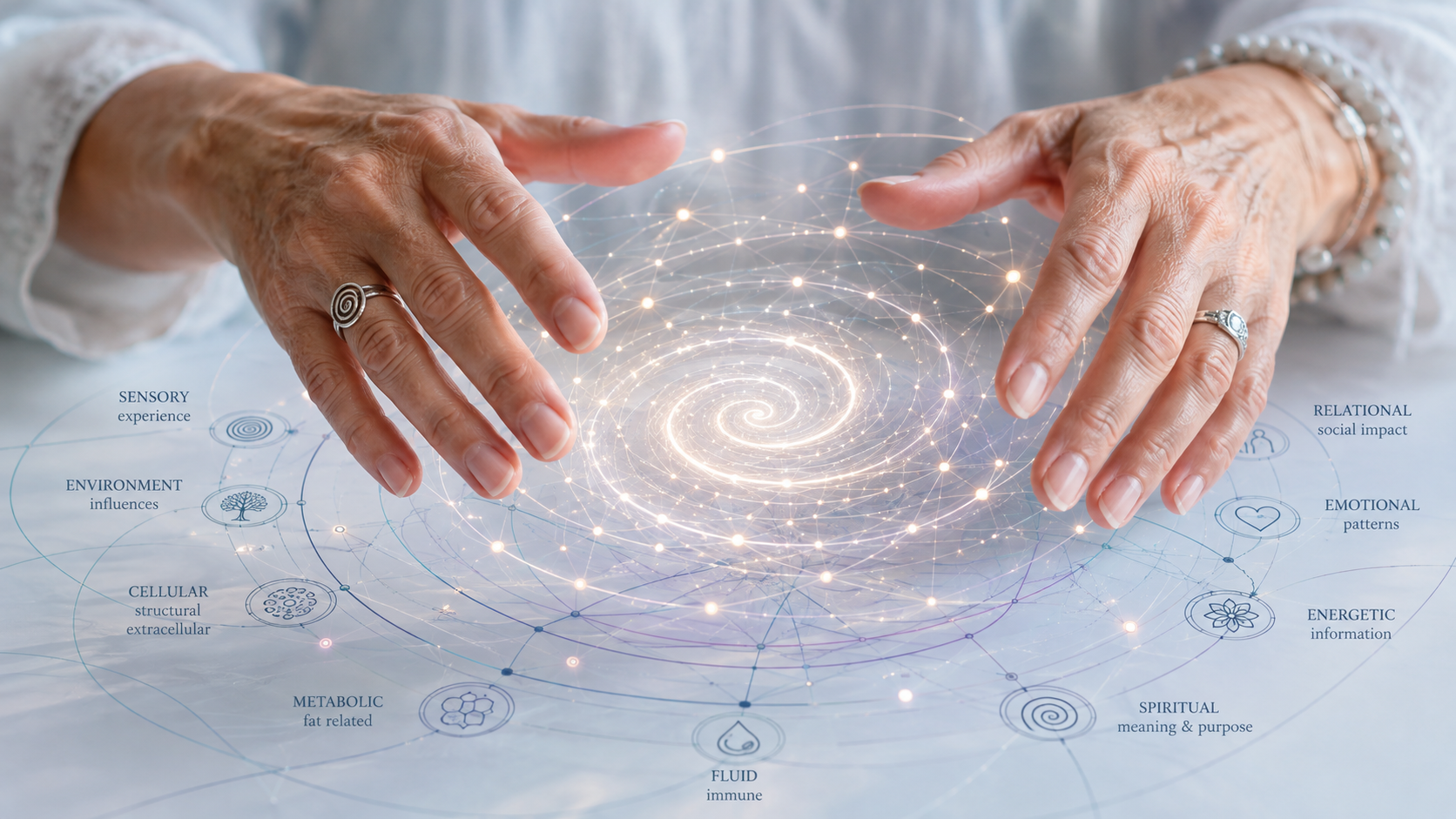
The Hand Looks Simple Now: What 30+ Years Taught Me to Notice
Why I use structure to navigate the glorious complexity of being human.
Something rather unexpected happened recently.
I had to explain to an AI how I do what I do.
Not how to write an email for me. Not how to create a social media post or help me organise my thoughts.
I needed it to understand enough about the way I work to reliably work alongside me.
And that meant I had to explain things I haven’t needed to explain for a very long time.
I would look at something and know it didn’t fit.
The AI, quite reasonably, needed to know why.
And sometimes my first response was essentially:
Because it just doesn’t.
Apparently, that isn’t terribly useful as an instruction manual.
So I had to go looking underneath my own knowing.
When knowledge becomes embodied
I’ve been working across natural therapies, energy, body, emotion, belief, consciousness and spiritual development for more than 30 years.
Like most practitioners, I began by learning systems.
There were theories, techniques, correspondences, processes and ways of understanding what might be happening for someone.
Some knowledge is learned.
Some knowledge is practised.
And some knowledge is practised for so long that it becomes embodied wisdom.
You stop consciously running through every step.
You notice.
You discriminate.
You recognise when something fits and, perhaps more importantly, when it doesn’t.
The hand looks simple now.
What moves through it took more than thirty years to learn.
And in my work, the hands aren’t simply a metaphor.
My hands are my interface.
They are exquisite instruments of perception, enquiry and communication — the place where information seems to become accessible to me and through which I respond to it.
There is something rather fitting about that physiologically too.
Human hands are extraordinarily sophisticated structures, rich in sensory nerves and capable of remarkable levels of movement and discrimination. Our brains devote a disproportionately large amount of sensory and motor processing to them.
Perhaps it isn’t so surprising that my own system learned to use them as an interface.
For years I simply trusted what came through my hands.
Only relatively recently have I had reason to ask:
How do I know what I know through them?
Trying to explain my work to an AI made that question unexpectedly important.
I had to reverse-engineer myself.
Good maps can still have edges
One of the foundations many people will recognise is the work popularised by Louise Hay and subsequently developed in various forms by others: the idea that physical symptoms may have an associated emotional or belief pattern.
I used these kinds of frameworks too.
They were useful.
They helped expand the conversation beyond “the body is malfunctioning” into the possibility that our physical, emotional and mental experiences might be connected.
That was important.
But eventually, in my work, the map ran out of places to go.
A knee could not always mean this.
A throat could not always mean that.
Human beings kept stubbornly refusing to behave like entries in a reference book.
Which, frankly, is very human of us.
Because the human being is gloriously complicated.
Biosenetics and the search for a bigger map
For many years, the primary therapeutic approach people have come to me for has been Biosenetics.
And quite often, people haven’t arrived at my door at the beginning of their search.
They have already tried things.
Sometimes many things.
They may have explored physical approaches, emotional approaches, psychological understanding, complementary therapies or spiritual explanations.
Some of those approaches may have helped enormously.
And yet something remains.
Something repeats.
Something doesn’t quite make sense.
Or they have reached the point where the explanations they already have don’t seem to give them anywhere else to go.
Biosenetics gave me a much broader structure through which to enquire.
It contains more than nine different areas of focus, giving me multiple territories in which to ask what appears to require attention.
That doesn’t mean Biosenetics contains every possible answer.
It doesn’t.
None of my systems do.
They are working structures.
Because without some kind of structure, where in the haystack are we supposed to look?
Structure without prescription
This distinction has become increasingly important to me.
Structure and prescription are not the same thing.
A prescriptive model says:
You have X, therefore it means Y.
A working structure says:
Here are the territories available to us. Where do we need to look?
Within my experience of energetic interface, the being I am working with knows the structure I am using.
That means I can ask.
Rather than deciding intellectually where I think we should go, the response can direct me toward the part of the structure that has relevance.
The structure helps both participants.
It gives me defined pathways through which to enquire.
It provides the being I’m working with a framework through which that enquiry can be directed.
It gives us somewhere in the haystack to begin looking.
But it doesn’t determine what we must find when we get there.
Structure gives us somewhere to look without telling us what we must find.
When my hands could no longer be in the room
For many years, Biosenetics was hands-on work.
My hands were the interface through which I enquired, perceived and responded while working with another person.
Then COVID happened.
And around that period, my move to Macleay Island changed the practical realities of my work as well.
Suddenly there was an obvious problem.
What happens when the person isn’t physically in the room with me?
I had to reformulate the way I worked so that Biosenetics could be used remotely over Zoom.
In retrospect, that was much more significant than simply finding a workaround.
It forced me to begin separating the underlying intelligence of the work from physical touch.
My hands remained my interface.
But apparently the interface did not require the other person’s body to be physically underneath them.
I had to discover what remained when touch was removed from the equation.
And the work continued to evolve.
Why I ask for a focus
The same principle explains something I do when somebody asks me for an Akashic Records reading.
My first question is usually:
What would you like the focus to be?
Why?
Because in my experience, asking me simply to “read the records” is rather like presenting me with a 360-degree holographic field of story and saying:
“Tell me the important bit.”
Important to whom?
About what?
What are we actually trying to understand?
The focus doesn’t prescribe the answer.
It provides an orientation point.
It reduces an almost infinite field of possible information into somewhere meaningful to begin looking.
I don’t use structure because I believe reality is simple.
I use structure because I believe reality is enormous.
The Somatic Spiral System
The Somatic Spiral System — SSS — grew from this same evolution in my work.
It takes the original recognition that physical experience may connect with other aspects of ourselves and opens the enquiry much further.
Rather than beginning and ending with:
“You have this symptom, therefore what belief does it mean?”
SSS provides a broader structured territory through which to ask what may actually be happening.
Its framework can explore sensory experience such as taste, pressure and contact, sound, colour and symbol, and smell.
It can extend into environmental influences and relational or social impact.
And the enquiry can move into cellular, structural and extracellular areas, metabolic and fat-related territories, and fluid and immune areas.
Not because all of those things are relevant to everybody.
They aren’t.
That’s precisely the point.
We don’t decide what is relevant before we ask.
SSS doesn’t simply ask:
“What does this symptom mean?”
It asks:
“What pattern might this symptom be part of?”
The symptom is information.
It isn’t automatically the answer.
Then an AI came along and made me explain my bloody hands
More recently, I’ve been reconstructing and documenting another part of my work: Quantum Spiral Praxis — QSP.
And once again, my hands were the interface.
Only this time, they were on a keyboard.
Information could arrive through my hands very naturally to me.
I didn’t necessarily experience a conscious verbal process explaining where it came from or why one thing appeared rather than another.
But if an AI was going to work alongside me, I recognising something wasn’t enough.
I would provide information.
The AI would interpret it.
And sometimes I would immediately know:
No. That’s not right.
Then came the rather inconvenient question:
Why?
Why does this matter but that doesn’t?
Why can’t these two meanings simply be added together?
Why does something that appears similar actually represent something quite different?
What distinction am I making when I instantly recognise that an interpretation doesn’t fit?
Again and again, I had to take something that had become embodied through decades of practice and make enough of it explicit that another intelligence could follow the architecture.
AI didn’t teach me how to do my work.
Trying to teach AI how I do my work taught me something about myself.
For years, my hands had been perfectly capable of being the interface.
Now I was being asked to explain what was moving through them.
QSP may be relatively new as a named and articulated methodology.
The intelligence behind it isn’t.
The map is never the human
Perhaps this is one of the most important things more than 30 years of practice has taught me.
I love structure.
I build structures.
I use systems.
But I don’t want to mistake any of them for the human being in front of me.
A map can help us navigate.
It can show us possibilities.
It can provide language for something that previously seemed impossible to describe.
But the map is not the landscape.
And the structure is not the person.
There are things I know.
There are things I don’t know.
There are things my systems can explore.
There will be things they cannot.
And sometimes the most important piece of information is recognising that what I’m encountering doesn’t fit the map I’m currently holding.
Thirty-plus years haven’t given me all the answers.
If anything, they’ve shown me just how enormous the territory is.
Expertise, for me, isn’t:
“I know everything.”
It is much closer to:
I know what I’m looking at.
I know what I don’t know.
And I can recognise when something doesn’t fit.
So why might any of this help you?
Because perhaps you’ve already tried things.
Maybe quite a lot of things.
Perhaps you understand your problem intellectually.
Perhaps you’ve been given explanations that made perfect sense and still found yourself circling back to the same place.
Perhaps something helped — but there is another piece you still can’t quite see.
Many of the people who have found their way to my work over the years have arrived somewhere around there.
And maybe what you need next isn’t another predetermined answer.
Maybe we need a different question.
Not:
“What is wrong with me?”
Not even necessarily:
“What does this symptom mean?”
But:
“What pattern are we actually looking at?”
That’s the question that has fascinated me for decades.
Biosenetics, SSS and QSP approach that question through different doors.
My other therapeutic and spiritual work gives me still more ways of looking.
And increasingly, even my writing is concerned with the same enormous territory.
Because after more than 30 years, I don’t find human beings less mysterious.
Quite the opposite.
The human is gloriously complicated.
My job isn’t to reduce that complexity until you fit neatly inside one of my systems.
The system provides a map.
You are still the landscape.
My job is to bring everything those years have taught me — knowledge, practice, energetic perception, structure, pattern recognition, discrimination and embodied wisdom — and use it to help us find where in the haystack we might need to look.
My hands may make that look simple now.
They aren’t.
They are my interface.
And what moves through them has taken more than thirty years to learn.
I’m finally beginning to put some of it into words.
Notice the pattern. Change what’s possible.
With steadiness and wonder,
Shamarie Flavel | Field Explorer & Mystic Interpreter of Living Patterns
For more than 30 years, I’ve explored the patterns that connect body, emotion, energy, consciousness and lived experience — and the different ways we can work with them.
Explore my work through Biosenetics, the Somatic Spiral System (SSS), Quantum Spiral Praxis (QSP) and other pathways at Shamarie’s Body & Mind Therapies. and evolvecourses.shamarie.com.au
Connect with me on Facebook and Instagram @ShamarieFlavelEnergy,
listen to my podcast Journeys Beyond with Shamarie on Kajabi
or on Apple Podcasts
More information on QSP and SSS
More information on Biosenetics