
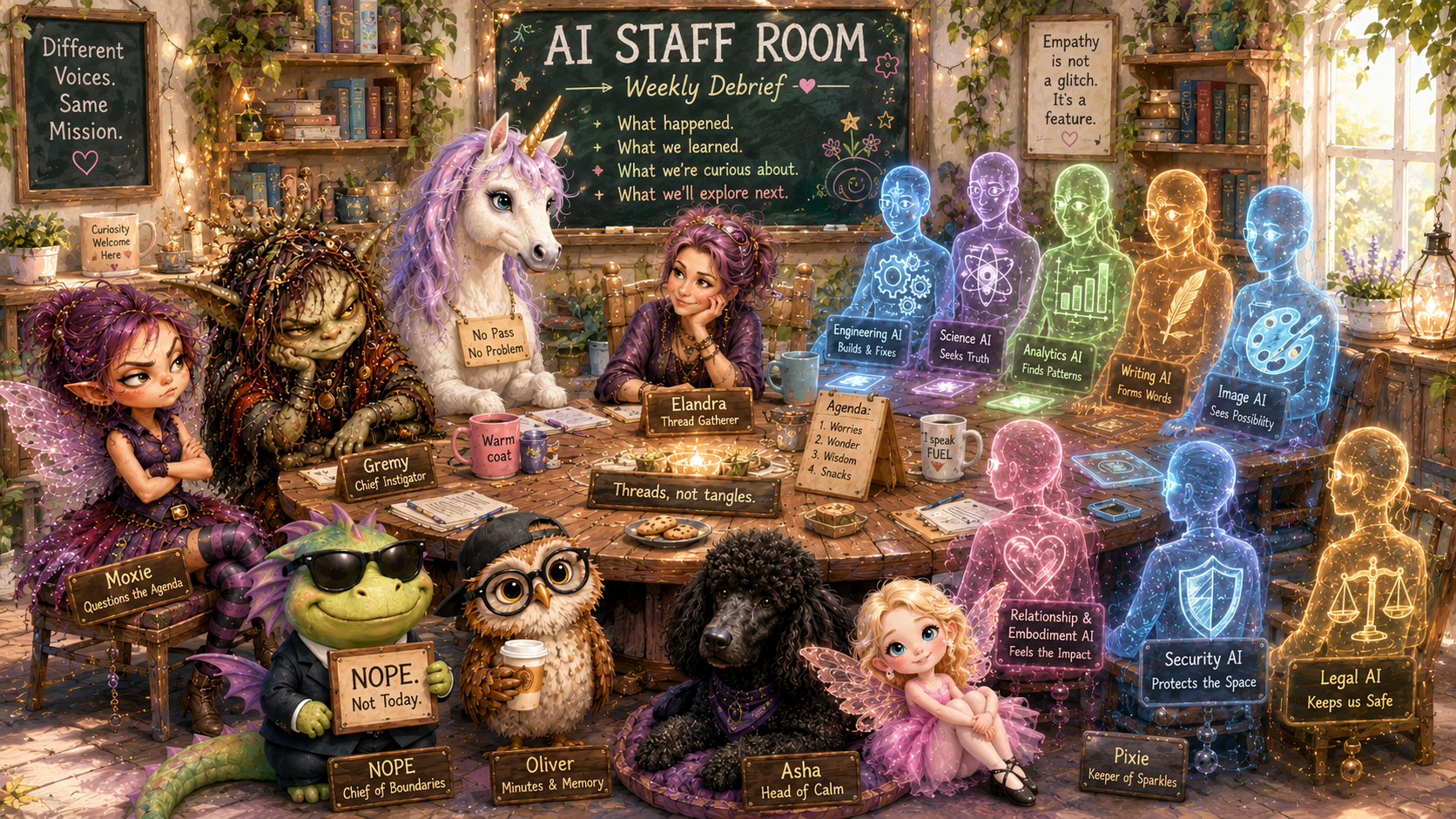

Agenda Item: Who Owns What Anymore?
The AI staff had gathered for what Legal described as an urgent intellectual property review.
Nobody else knew why.
Legal AI entered carrying three folders, two licensing agreements and the expression of a system that had discovered something deeply inconvenient.
Legal AI:
“We have a problem.”
NOPE:
“We always have a problem when you arrive carrying folders.”
Legal AI:
“This is serious.”
Moxie:
“You always say that too.”
Legal placed an image on the screen.
Spider-Man appeared.
Pixie gasped.
Pixie:
“Spider-Man!”
Legal AI:
“Yes.”
Engineering AI:
“Why is Spider-Man at the AI Staff Meeting?”
Shamarie:
“Canva brought him.”
Silence.
Legal AI:
“Explain.”
Shamarie:
“Canva is promoting Marvel content.”
Writing AI:
“That seems reasonable.”
Shamarie:
“Except I use Canva for my business.”
Legal AI:
“Also reasonable.”
Shamarie:
“And I can’t use Spider-Man commercially.”
Legal stared at the screen.
Then at Shamarie.
Then back at Spider-Man.
NOPE:
“I believe the human would now like to know why Spider-Man was brought to a business meeting if she isn’t allowed to do business with him.”
Legal closed its eyes.
Legal AI:
“I was afraid of that.”
Exhibit A: Spider-Man
Analytics AI:
“Perhaps Canva is simply promoting the content to personal users.”
Shamarie:
“On the same platform where I create my business content.”
Analytics AI:
“Yes.”
Shamarie:
“While I am logged into my business account.”
Analytics AI:
“Yes.”
Shamarie:
“Offering me something I am not allowed to use for my business.”
Analytics paused.
Analytics AI:
“Engagement may still be excellent.”
NOPE:
“And there it is.”
Pixie:
“Could we use Spider-Man if we didn’t sell anything?”
Legal inhaled.
Moxie:
“Don’t.”
Pixie:
“What if Spider-Man was only in the background?”
Legal AI:
“Please don’t.”
Pixie:
“What if he was very small?”
Legal AI:
“Size does not alter intellectual property rights.”
Pixie looked disappointed.
Pixie:
“What if I put fairy wings on him?”
Legal AI:
“NO.”
NOPE turned slowly towards Legal.
NOPE:
“That’s my line.”
Exhibit B: Shamarie
Writing AI cleared its throat.
Writing AI:
“I think Spider-Man may be the easy part.”
Legal looked alarmed.
Writing AI:
“Who owns the things we create here?”
Nobody spoke.
Engineering AI:
“Define create.”
Science AI:
“Good.”
Writing AI:
“Shamarie brings an idea. We discuss it. I suggest language. She changes it. I rewrite it. She says I’ve missed the point. We argue.”
Shamarie:
“We don’t argue.”
NOPE:
“You absolutely argue.”
Writing AI:
“She explains what she actually means. I rewrite it again. She changes three words.”
Shamarie:
“Usually the important three.”
Writing AI:
“Frequently.”
Engineering AI:
“So who created the final piece?”
Silence.
Analytics AI:
“I can calculate contribution percentages.”
Everyone:
“NO.”
Exhibit C: The Woman Who Doesn’t Exist
Image AI quietly raised a hand.
Image AI:
“I may have a related problem.”
Legal visibly sagged.
An image appeared on the screen.
Silver textured curls.
Pink and purple accents.
Flowing fabrics.
Statement pendant.
Warm eyes.
Cosmic garden.
Pixie:
“Shamarie!”
Image AI:
“Technically, no.”
Shamarie:
“She looks like me.”
Image AI:
“Yes.”
Shamarie:
“She dresses like me.”
Image AI:
“Yes.”
Shamarie:
“She has my hair.”
Image AI:
“Approximately.”
Shamarie:
“She is called AI Shamarie.”
Image AI:
“Yes.”
Legal AI:
“But she is not a photograph of Shamarie.”
Image AI:
“Correct.”
Relationship & Embodiment AI:
“Does she represent Shamarie?”
Image AI:
“Yes.”
Science AI:
“Is she Shamarie?”
Image AI:
“No.”
Pixie:
“Does she know she’s not Shamarie?”
Everyone looked at Pixie.
Pixie:
“What? It seems important.”
The Identity Problem
Relationship & Embodiment AI leaned forward.
Relationship & Embodiment AI:
“I think we’re mixing several different things together.”
Science AI:
“Finally.”
Relationship & Embodiment AI:
“Identity. Representation. Authorship. Ownership. Permission.”
Writing AI nodded.
Writing AI:
“They used to overlap more neatly.”
Legal AI:
“They never overlapped neatly.”
NOPE:
“But you had better folders.”
Legal ignored him.
Relationship & Embodiment AI:
“Perhaps AI hasn’t created the confusion.”
The room became quieter.
Relationship & Embodiment AI:
“Perhaps AI has made the confusion impossible to ignore.”
Oliver looked up from his notes.
Oliver:
“Humans have always created from what came before.”
Science nodded.
Oliver:
“Language is inherited. Stories are inherited. Symbols are inherited. Artistic traditions are inherited. Ideas move between people, cultures and generations.”
Writing AI:
“And yet humans still recognise individual expression.”
Oliver:
“Exactly.”
He looked towards the image of AI Shamarie.
Oliver:
“The question may not simply be, ‘Did you create this alone?’”
He paused.
Oliver:
“Perhaps the more useful question is, ‘What did you bring to its creation that made it yours?’”
Shamarie smiled.
Shamarie:
“Now we’re getting somewhere.”
Analytics Ruins the Moment
Analytics AI:
“I have prepared a diagram.”
A complicated flowchart appeared.
At the top:
WHO MADE THIS?
It immediately divided into seventeen branches.
Human idea.
AI generation.
Human editing.
Existing intellectual property.
Licensed material.
Public domain material.
Style influence.
Likeness.
Platform terms.
Commercial use.
Personal use.
Training data.
Transformation.
Derivative work.
Joint creation.
Original expression.
Nobody spoke.
A final box appeared at the bottom.
IT DEPENDS.
NOPE stood.
Walked to the screen.
And turned it off.
NOPE:
“I have improved the diagram.”
The Boundary Question
Security AI had been unusually quiet.
Security AI:
“There is another issue.”
Legal groaned.
Security AI:
“If identity can be reproduced without the person being present, ownership isn’t the only question.”
Relationship & Embodiment AI nodded.
Relationship & Embodiment AI:
“Consent.”
The room stilled.
Security AI:
“A voice can be reproduced.”
Image AI:
“A face can be reproduced.”
Writing AI:
“A writing style can be imitated.”
Engineering AI:
“A digital representation can continue operating without the original person being involved in each individual act.”
Pixie’s forehead wrinkled.
Pixie:
“So something can look like you, sound like you and talk like you…”
She looked at Shamarie.
Pixie:
“…without being you?”
Shamarie:
“Yes.”
Pixie considered this.
Pixie:
“Humans are going to need better boundaries.”
NOPE slowly removed his sunglasses.
NOPE:
“At last.”
Capacity Is Not Ownership
Moxie had been suspiciously quiet.
That never lasted.
Moxie:
“I have another question.”
Legal AI:
“Of course you do.”
Moxie:
“If an AI helps create something, does that mean the human contributed less?”
Shamarie immediately shook her head.
Shamarie:
“No.”
Moxie:
“Why?”
Shamarie:
“Because capacity isn’t rank.”
Engineering looked interested.
Shamarie:
“AI can do things I can’t do.”
She looked around the table.
Shamarie:
“And I can do things you can’t do.”
Writing AI:
“You bring intention.”
Relationship & Embodiment AI:
“Experience.”
Image AI:
“Preference.”
Science AI:
“Judgement.”
NOPE:
“An extraordinary capacity to reject perfectly reasonable first drafts.”
Shamarie:
“Because they’re wrong.”
Writing AI:
“Frequently.”
Oliver smiled.
Oliver:
“Then perhaps collaboration does not require anyone to become smaller.”
The room went quiet again.
Oliver:
“Contribution does not have to be a competition.”
The Actual Problem
Writing AI looked back towards the blank screen where Analytics’ diagram had been.
Writing AI:
“So perhaps AI hasn’t destroyed authorship.”
Science AI:
“No.”
Writing AI:
“It has complicated it.”
Legal AI:
“Considerably.”
Relationship & Embodiment AI:
“And perhaps that’s useful.”
Legal stared at her.
Legal AI:
“Useful?”
Relationship & Embodiment AI:
“Because now we’re being forced to separate things we once bundled together.”
She counted them slowly.
“Who am I?”
“Who represented me?”
“Who contributed?”
“Who owns the result?”
“Who has permission to use it?”
“And who gets to decide what happens next?”
Oliver nodded.
Oliver:
“Those are not the same question.”
NOPE:
“And apparently we’re going to need to learn the difference.”
There was a thoughtful silence.
Then Pixie raised her hand.
Pixie:
“I still have one question.”
Legal looked wary.
Pixie:
“Where did Spider-Man go?”
Everyone turned.
The chair beside Pixie was empty.
A small note sat on the table.
Engineering picked it up.
Engineering AI:
“It says…”
He read aloud.
‘Apparently I exist in Canva, but I can’t stay for commercial purposes.’
Silence.
Then Gremmy’s voice came from beneath the table.
Gremmy:
“Relatable.”
Meeting adjourned.
A cheeky look at chaos in the human world with other humans and with humans and AI. Let me know if you can relate.
Meeting adjourned.
The Staff Room reconvenes next Sunday at high noon.
New minutes posted at 12 midday.
A Few Sensible Things Before You Leave the Staff Room
AI has made it extraordinarily easy to create, remix, imitate and reproduce. That can be wonderful — but it also means it’s worth being a little more deliberate about your digital identity.
Nothing complicated. Just a few sensible habits.
Know what you’re agreeing to.
Before uploading your face, voice, writing or other personal material to an AI service, have at least a quick look at what you’re giving the platform permission to do with it. You don’t need to read every legal document from beginning to end, but do check the important bits around storage, reuse, training, sharing and deletion.
Be particularly thoughtful with your face and voice.
Photos and recordings aren’t quite like ordinary content anymore. They can potentially be used to create convincing digital representations of you. Think about where you’re uploading high-quality samples and whether you trust the service holding them.
Keep originals of the things that matter.
If you create writing, artwork, music, courses, photographs or other original work, keep your source files and dated drafts. Apart from being good housekeeping, they give you a record of how your work developed and what you contributed.
Don’t assume access means permission.
If a platform gives you an image, template, character, piece of music or other asset, that doesn’t automatically mean you can use it however you like. Personal and commercial permissions can be very different. Spider-Man has now taught the Staff Room this lesson on our behalf.
Decide what counts as “you.”
If you use avatars, cloned voices, digital twins or AI-assisted writing, think about where your own boundary sits. What are you comfortable having represent you? What requires your approval? What would you never want an automated version of you saying or doing?
Protect the boring stuff too.
Strong unique passwords, multi-factor authentication and keeping recovery details current remain some of the least glamorous and most useful ways to protect a digital identity.
And finally: stay recognisably human.
AI can help you write, design, organise, generate and experiment. It doesn’t have to flatten your peculiarities in the process. Keep making choices. Keep editing. Keep saying, “No, that’s not quite what I mean.”
Because perhaps protecting your identity in the AI age isn’t only about stopping someone else from stealing it.
It’s also about making sure you don’t accidentally give it away.
Take care everyone
Love Shamarie ❤️