
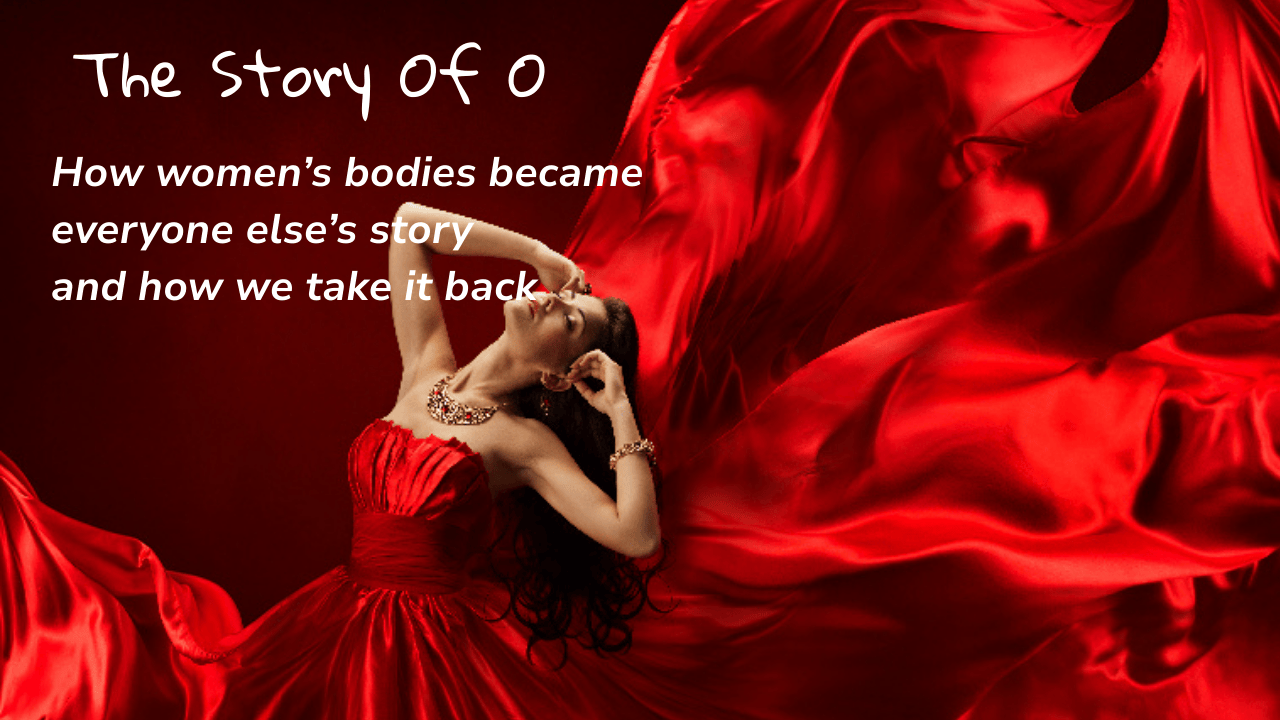
Some of you may remember the old film The Story of O — a controversial piece about power, surrender, objectification, and the shaping of a woman’s identity through power dynamics.
Others may only know it by reputation.
Either way, the point isn’t the plot.
The point is what the story reveals:
A woman defined by someone else’s idea of what she should be.
A self erased until she becomes an archetype instead of a person.
And this is where BOB enters.
BOB Is Not What You Think
Yes — you may think you know what BOB refers to.
A cheeky wink, a private joke, a toy.
But BOB also stands for something far more important:
- Boundary of Being
- Beacon of Becoming
- Breath of Belonging
- Bearer of Boundaries
- Bridge Out of Bullshit
And most of all:
BOB is a symbol of a woman returning to herself.
In the story that sparked this whole adventure, my sister’s BOB retired due to “catastrophic structural fatigue.” There were shrieks of laughter, tissues for tears (from both the hilarity and the honesty), and a sense that we had crossed some invisible threshold.
We were talking openly about something we were never taught to name, let alone discuss:
- Women’s desire.
- Women’s pleasure.
- Women’s private sovereignty.
The device itself is almost incidental.
What matters is the conversation it opened.
From O to BOB: Archetypes, Objects & Ownership
The Story of O gave us a very specific archetype:
A woman shaped, sculpted, and controlled by another’s desire.
A woman reduced to an object, her power outsourced, her boundaries porous.
Her worth measured by how fully she can surrender, comply, and please.
For many women, this isn’t just fiction. It’s an uncomfortable mirror.
We’ve grown up in systems where we are:
- Praised for self-sacrifice.
- Rewarded for silence.
- Expected to be endlessly emotionally available.
- Shamed for wanting “too much” — whether that’s rest, pleasure, or truth.
The result?
A quiet, chronic erasure of self.
BOB steps into this landscape as a disruptive archetype — not because he’s a discreet device in a drawer, but because of what he represents:
A woman choosing to prioritise her own connection to herself.
A woman daring to explore her own body on her own terms.
A woman saying, “I can know myself without waiting for you to understand me.”
BOB is a symbol of self-ownership instead of objectification.
Where O is written by another’s hand, BOB is where a woman starts to write herself.
Why This Matters in Midlife
By the time many of us reach midlife, we’ve walked decades of roles:
Daughter, partner, mother, carer.
Employee, boss, healer, space-holder.
The reliable one. The strong one. The sensible one.
Somewhere along the way, desire gets filed under “optional” or “luxury item.”
We might tell ourselves:
- “I’m too tired.”
- “It’s not that important.”
- “There are bigger things to worry about.”
- “This is just what getting older looks like.”
But beneath the surface, the body remembers.
The body remembers what it feels like to be alive, not just functional.
To be touched with presence, not obligation.
To be allowed to want, not just to give.
Midlife has a way of cracking the veneer.
Things that used to be tolerable become painful.
Roles that once fit now chafe.
Relationships, careers, identities built on “I’ll just cope” begin to wobble.
And sometimes, the catalyst for finally telling yourself the truth is surprisingly ordinary:
A retired BOB.
A stormy night.
A conversation with your sister that veers from laughter to revelation.
This is not just a story about a device.
It’s a story about a woman deciding:
“I belong to myself now.”
The Field, the Body & the Quiet Revolutions
Most of my work happens in the subtle realms:
- The field of information that surrounds us.
- The patterns that live in the nervous system.
- The echoes of unprocessed experiences stored in the body.
Clients come to me when their lives no longer make sense:
- The roles they’ve played are breaking down.
- Their bodies are speaking in symptoms.
- Their spiritual awakening feels more like a crisis than a blessing.
They are sensitive, deep-feeling, often high-functioning women who have spent years holding everything (and everyone) together.
Underneath their stories is a recurring theme:
“I’ve been living as an object in someone else’s story.
I don’t quite know how to live as the author of my own.”
This is where sovereignty enters — not as a lofty spiritual concept, but as a lived, embodied practice.
Sovereignty isn’t about domination or separation.
It’s about clear boundaries, self-trust, and a relationship with your own body that isn’t constantly outsourced.
BOB, in this context, becomes a playful but potent symbol of that reclamation.
Laughter as Medicine, Pleasure as Signal
Let’s be clear: we are not trivialising trauma, health, or spirituality.
We’re acknowledging that:
- Laughter is a nervous system event.
- Pleasure is information.
- Desire is a compass.
When you laugh — really laugh — your body gets a flood of signals that say:
- “For this moment, you are safe.”
- “It is possible to feel something other than vigilance.”
- “You are allowed joy.”
Laughter can loosen the grip of shame in places where solemnity sometimes tightens it.
Pleasure (and I mean this in a broad, inclusive sense — from a good cup of tea to deep sensual connection) signals to the body that life isn’t just about enduring.
When we bring humour and honesty into taboo topics like private devices, midlife desire, or the stories we hold in our bodies, we create a bridge:
From isolation to connection.
From shame to curiosity.
From “I shouldn’t feel this way” to “Of course I feel this way.”
BOB sits on that bridge with a mischievous grin, reminding us that:
- Healing doesn’t have to be humourless.
- Spirituality doesn’t have to float above the body.
- Sovereignty includes our sensual, laughing, fully-feeling selves.
From Performance to Presence
For many women, intimacy has been shaped by performance:
“What do they want?”
“Am I doing this right?”
“Do I look okay?”
“Is this enough for them?”
The attention is outward.
The body becomes a stage rather than a home.
BOB, in our metaphor, invites something radically different:
Presence.
There’s nobody to perform for.
No external gaze.
No pressure to be “good” at anything.
Just curiosity, sensation, feedback, and self-connection.
This shift — from performing for someone to being with yourself — is profound. It changes how you:
- Hear your body’s no.
- Trust your body’s yes.
- Recognise when you’re abandoning yourself in everyday life.
And here’s the important part:
Once you’ve experienced this kind of honest, internal presence, it becomes much harder to keep playing old roles in other areas of your life.
You start to notice where you:
- Say yes when you mean no.
- Soften your truth to make others comfortable.
- Take responsibility for feelings that aren’t actually yours.
BOB may live in the drawer, but his impact ripples out into:
- Your relationships
- Your boundaries
- Your spirituality
- Your capacity to inhabit your own life
The Energetic View: What BOB Represents in the Field
If we step back and look from the field perspective, BOB sits at the intersection of several energetic themes:
- Self-sourcing vs outsourcing.
- Boundary vs fusion.
- Truth vs performance.
- Embodied spirituality vs disembodied ideals.
In my work with clients, these themes show up again and again — whether we’re talking about chronic illness, relationship burnout, or spiritual crisis.
BOB simply gives us a playful, relatable entry point.
It’s much easier to talk about “the discreet device in the drawer” than to jump straight into “let’s discuss your inherited patterns of self-abandonment and the medicalisation of your body.”
But make no mistake: we are talking about the same field.
Sovereignty, Soft Rebellion & the Archetypes That No Longer Fit
This isn’t a book about a device.
It’s a book about what the device represents.
BOB is a symbol — a humorous one, yes — but underneath the laughter is something far more important:
- A woman choosing herself.
- A collapse of old archetypes.
- A return to the body.
- A return to sovereignty.
If you’ve ever:
- carried more than your share
- shapeshifted to keep the peace
- felt responsible for everyone else’s emotions
- swallowed your truth to avoid the storm
- wondered who you might be without the caretaking
- laughed quietly at your own rebellion
…then this story may feel like a homecoming.
It’s an invitation to consider:
Where have I been living as “O” — an object in someone else’s narrative?
Where might my own inner BOB be asking for recognition — the part of me that knows I belong to myself?
A Glimpse of What’s Coming
This blog is part of the prelude to my upcoming book:
The Discreet Device: A Gentlewoman’s Guide to Private Joy.
It’s a tongue-in-cheek, heartfelt exploration of:
- Midlife reinvention
- Desire, dignity and discreet devices
- Sisterhood, spirituality and sovereignty
- The ways women quietly reclaim themselves from the inside out
There will be laughter. There will be honesty. There will be conversations many of us were never allowed to have.
And woven through it all will be the same threads I work with in my healing practice:
- Nervous system repair
- Field awareness
- Soul-level choice
- The deep, steady remembering of who you really are
If this blog stirred something in you — whether discomfort, relief, curiosity or a slightly wicked smile — you’re exactly who I’m writing for.
Because sometimes sovereignty whispers.
And sometimes it arrives with lightning, a stormy night, and a retired BOB.
With steadiness and wonder,
Shamarie Flavel | Field Explorer & Mystic Interpreter of Living Patterns
Join me in exploring how energy, awareness, and daily life weave together to create a sanctuary of coherence and calm. 🌿
Connect with me on Facebook and Instagram @ShamarieFlavelEnergy,
listen to my podcast Journeys Beyond with Shamarie on Kajabi
or on Apple Podcasts
join our private Facebook community Evolve Courses Group to share and grow together, or explore my courses and offerings at evolvecourses.shamarie.com.au.
👉 Be the first to know when BOB lands in the world (and get launch-only bonuses) – add your name to the BOB waitlist. https://evolvecourses.shamarie.com.au/signup