
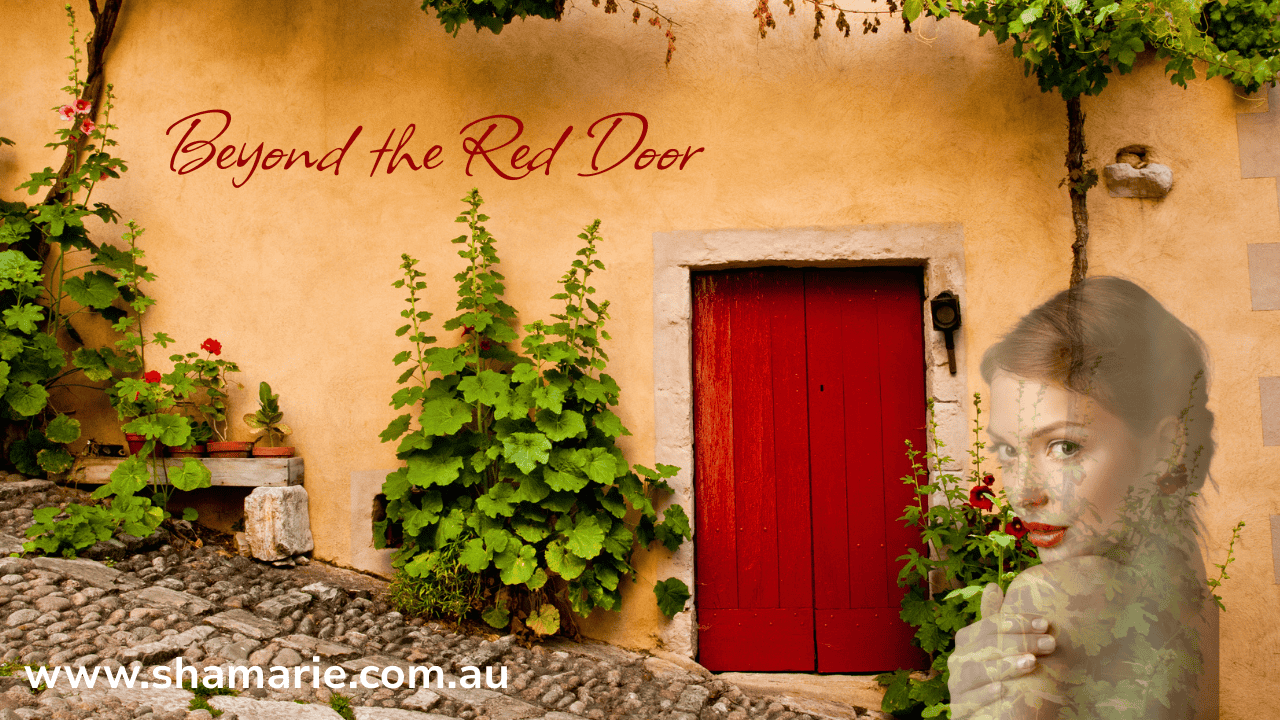
The other night I went hunting for images.
I was looking for red doors, secret gardens, beautiful bedrooms – visual metaphors for my upcoming BOB project. Soft, bohemian, a little mysterious, very much about a woman’s private sanctuary.
I typed in things like “red door” and “beautiful bedroom”.
And what did the search engines decide I meant?
Not doors.
Not gardens.
Not even bedrooms, at first.
Bodies.
Beautiful women’s bodies posed like doorways.
Lips, legs, lingerie.
Women arranged as décor.
Because of course… in the eyes of the algorithm, “beautiful + behind closed doors” must mean a woman ready to be looked at, desired, consumed – not a woman who has simply chosen herself.
It was a very sharp reminder that for all our talk of empowerment and equal rights, the objectification model is still alive and well.
We’ve had several waves of feminism.
We can vote.
We can own property.
We can work, divorce, open bank accounts, say no on paper.
And yet, in the collective field, the default image attached to “beautiful” is still:
A woman’s body, arranged for someone else’s gaze.
No wonder BOB is stirring things up.
A very short, very imperfect history of feminism
I’m not going to give you a full academic tour – there are brilliant people who do that far better than I can. But for the sake of context, here’s a very simple sketch.
-
First wave feminism fought for legal personhood.
The right to vote, to own property, to exist in law as something other than a man’s extension. -
Second wave pushed into work, education, marriage, reproductive rights.
“The personal is political” began to crack open the private sphere. -
Third and fourth waves brought in intersectionality, diversity, #MeToo, body positivity, queer and trans rights, calling out the deeper layers of patriarchy, racism and harm.
Each wave has given us something essential.
I would not be doing my work, and you would not be reading this, without those women.
And yet.
So much of the outer work has been about gaining access to existing structures:
parliament, the workplace, the boardroom, the law.
We were invited (sometimes grudgingly, sometimes proudly) to step into male-designed models of power and success:
-
Work like a man.
-
Lead like a man.
-
Desire like a man.
-
Compete like a man.
Even our cultural picture of a “strong, independent woman” has often looked suspiciously like… a man in different shoes.
Meanwhile, the objectification model trundled on in the background:
the idea that a woman’s value is primarily in how she appears to others.
Which brings us back to BOB, and why he keeps smirking at me from the corner of the room.
BOB and the “final frontier” of liberation
If you haven’t met BOB yet, he’s the discreet device–turned–book muse who has wandered into my work as both a joke and a very serious archetype.
On one level, he’s comic relief:
a way to talk about women’s desire, ageing, sovereignty and pleasure without disappearing in a cloud of euphemisms and clinical language.
On another level, he’s a marker of what I think might be the unfinished work of feminism:
Women stepping outside the objectification model
and into self-originated, self-sourced power.
The right to choose our own relationship with:
-
Our bodies
-
Our sexuality (including not feeling sexual)
-
Our desire, libido and cycles
-
Our softness, our anger, our tenderness
…without measuring any of it against what is “marketable,” “palatable,” or “Instagram-ready”.
When BOB “speaks” in my work, he has a particular tone: part mischief, part truth serum.
One of the lines he offered for an interview script was:
“If women’s liberation never makes it as far as the bedroom, it isn’t finished.”
And that, to me, is the crux.
For all our strides in public life, many of us are still living in bodies that feel:
-
Inspected
-
Graded
-
Compared
-
And, ultimately, not quite ours
We still apologise for taking up space.
We still contort ourselves to be attractive, agreeable, acceptable.
We still internalise the gaze that says, “You are okay as long as you are pleasing.”
BOB, in his cheeky way, is a symbol of stepping out of that frame.
He is not about replacing men.
He is not about giving up on relationship or partnership.
He’s about saying:
“My body, my pleasure, my aliveness are not auditions for someone else’s approval.
They are mine. I am the subject here, not the object.”
That is a different kind of feminism.
Quieter on the streets, perhaps.
Very loud in the nervous system.
The “strong independent woman” we were sold vs the one we actually are
When I was younger, the image of a “strong, independent woman” often came packaged as:
-
Unbothered
-
Hyper-competent
-
Emotionally contained
-
Sexual, but not too sexual
-
Successful in the workplace, holding everything together, needing no one
In other words: a woman who had learned to play the game like a well-behaved man,
while still being decorative.
It was an upgrade from “silent, obedient housewife,”
but it still wasn’t ours.
The model was:
step into his world, learn his rules, and be impressive there.
What I see emerging now – especially in midlife women – is something different.
A strong, independent woman who:
-
Can feel deeply and still function.
-
Can say “no” without cushioning it with six apologies.
-
Can say “yes” to pleasure, rest, softness, or wildness without needing it to be “productive”.
-
Can be in relationship without losing herself.
-
Can choose partnership, solitude, BOB, or all of the above at different seasons – from sovereignty, not from scarcity.
She’s not trying to become “like a man.”
She’s not trying to be the “cool girl” version of feminism – the one who is never upset, never needy, never messy.
She’s experimenting with something more radical:
“What if I let myself be fully human in a woman’s body… and built my life from there?”
That includes her mind, her field, her nervous system, and yes – her sexuality.
Not sexuality as performance.
Not sexuality as currency.
But sexuality as one thread in her aliveness.
Beyond the red door: from object to origin
So what does all this have to do with red doors and image searches?
For me, that little late-night encounter with the algorithm summed it up.
I typed in “red door” and “beautiful” to find a metaphor for a woman’s private, inner sanctuary.
The internet tried to hand me back a catalogue of women’s bodies to be looked at.
It revealed, in a very literal way, the gap we’re standing in:
-
We have the language of empowerment,
-
But the imagery – the reflexive template – is still objectification.
Part of BOB’s project, as I feel it, is to quietly reverse that arrow.
To move us from object to origin.
From:
“I am here to be seen, chosen and approved of,”
to:
“I am the origin point of my choices, my pleasure, my boundaries, my life.”
The red door is no longer the threshold into someone else’s fantasy.
It’s the entrance to her own secret garden.
Sometimes that garden includes sex.
Sometimes it includes long dry seasons, grief, rage, healing, re-learning her body from the inside out.
Sometimes it includes a discreet device on the top shelf and no interest in dating whatsoever.
All of that can be sovereign.
What matters is who the story centres.
A gentle invitation
I’m not asking you to throw away your lipstick, your pretty dresses, your love of being seen.
Objectification isn’t about loving beauty; it’s about being trapped inside someone else’s idea of what that beauty is for.
So here’s a gentle question you might play with:
“In this moment, am I the object… or the origin?”
When you get dressed.
When you post a photo.
When you say yes.
When you say no.
When you reach for pleasure, or turn toward rest.
You don’t have to get it “right”.
You don’t have to burn your old scripts overnight.
Just begin to notice where you’re still standing at the door of your own life, waiting to be invited in.
And where, quietly, you’re already holding the key.
BOB is one playful, irreverent way I’m choosing to explore this.
He gives us permission to laugh, to roll our eyes at the absurdity of the old scripts, and to talk about things women were “never meant” to say out loud.
But the real liberation isn’t about BOB at all.
It’s about you.
Your body.
Your story.
Your particular, unrepeatable way of being a strong, independent woman –
not by becoming like a man,
but by becoming more fully, unapologetically yourself.
Beyond the red door, the secret garden is waiting.
And it doesn’t exist for anyone’s gaze but your own.
With steadiness and wonder,
Shamarie Flavel | Field Explorer & Mystic Interpreter of Living Patterns
Join me in exploring how energy, awareness, and daily life weave together to create a sanctuary of coherence and calm. 🌿
Connect with me on Facebook and Instagram @ShamarieFlavelEnergy,
listen to my podcast Journeys Beyond with Shamarie on Kajabi
or on Apple Podcasts
join our private Facebook community Evolve Courses Group to share and grow together, or explore my courses and offerings at evolvecourses.shamarie.com.au.
and you can grab you copy of The Discreet Device AKA BOB here https://evolvecourses.shamarie.com.au/offers/FS8u6dXh/checkout