
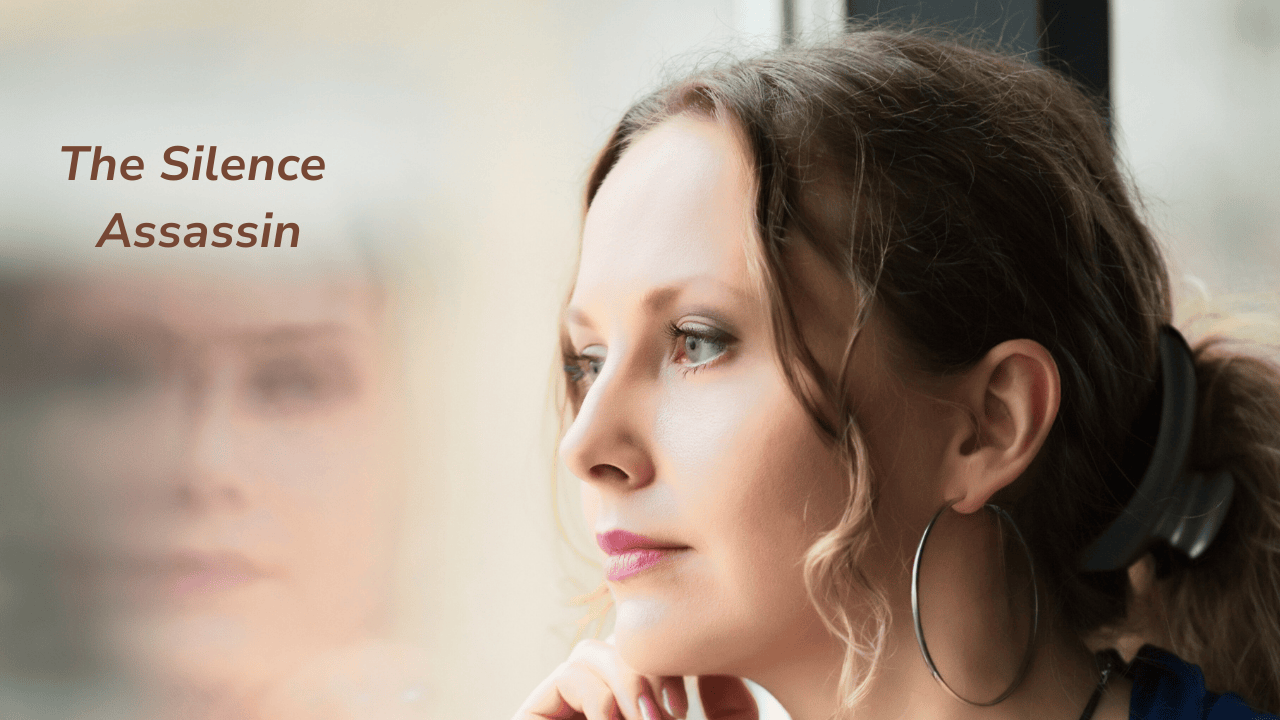
This time of year can be beautiful… and also quietly exhausting for sensitives.
If you’ve felt ‘on patrol’ lately, you’re not alone
If you read Many Eyes, read it here you’ll know the feeling: that strange pressure of being observed—by people, by expectations, by invisible social rules.
But here’s the part I didn’t fully see until recently:
Sometimes the Many Eyes don’t stay “out there.”
They move in.
They become a voice inside us. Quiet. Constant. Intelligent.
And it doesn’t just watch—it judges.
I call it the Silent Assassin.
Not because it’s dramatic.
Because it’s stealthy.
It doesn’t shout, “You’re wrong!”
It simply arranges your inner world so that you feel wrong… almost no matter what you do.
The Silent Assassin doesn’t need proof
One of the most disorienting things about the inner judge is that it can always find a charge.
If you didn’t know better, it says: “You should have.”
If you tried your best, it says: “Not good enough.”
If you made a choice, it says: “Why did you choose that?”
If something goes wrong, it says: “Look what you caused.”
It can convict you on intention, competence, hindsight, outcomes, and even basic human needs.
And if you’re a sensitive—someone who can feel atmosphere, mood shifts, and relational tension—the Silent Assassin often has a second job:
Managing other people’s reality… so you can feel safe.
The hidden contract: “If I manage the room, I won’t be punished”
Many sensitives learned a very old survival logic:
If I anticipate what others want…
If I keep the peace…
If I don’t make waves…
If I stay “not wrong”…
Then maybe I’ll be safe.
This isn’t weakness.
This is intelligence shaped by consequences.
For some of us, those consequences were obvious: shouting, shaming, withdrawal, emotional punishment, or worse. For others, it was subtler: the moods, the tension, the “walking on eggshells,” the endless cross-examination of ordinary choices.
Either way, the body learns:
“Don’t want too much.”
“Don’t take up space.”
“Don’t make it harder.”
“Don’t be selfish.”
And perhaps the most damaging one:
“If something hurts, it must be your fault.”
The white-collar version of harm
There’s a form of control that isn’t physical. It doesn’t leave bruises.
It leaves hypervigilance.
It shows up as interrogation:
“Why did you buy that?”
“Why do you want to do that?”
“Why did you do it like that?”
Or as a veto disguised as a feeling:
“I feel uncomfortable with that, so why are you doing it?”
(Instead of: “I notice discomfort in me—let me explore why.”)
Or as “mood weather”:
the waiting game
the tension in the air
the sense that a storm is coming and you should pre-empt it
This is why sensitives can feel exhausted even when “nothing happened.”
Because something did happen internally: the nervous system stayed on patrol.
The self-soothing trap
Here’s another place the Silent Assassin hides:
Self-soothing.
When you’re overwhelmed, tired, or emotionally worn thin, the body looks for relief. Food, scrolling, shutting down, avoiding the hard task, skipping movement—whatever brings comfort quickly.
But if “doing something for yourself” used to come with punishment, then your soothing becomes a trap:
you soothe
you feel relief
then the judge arrives with the invoice
“You shouldn’t.”
“You always do this.”
“Now look what you’ve done.”
So even comfort becomes contaminated.
And the pain isn’t only the calories, or the lack of exercise, or the procrastination.
The deeper pain is this: you don’t feel allowed to be human without being sentenced.
The Good Samaritan problem
There’s a bigger story underneath all of this—one we see everywhere.
Someone gets hurt on a dangerous road, and instead of asking:
“Why is the road dangerous?”
we ask:
“Why were you there?”
“Why didn’t you do XYZ?”
“Why didn’t you prevent it?”
This is where victim-blame lives.
It’s where women are told to manage their safety as an endless checklist—and still not be safe.
It’s where poverty is explained as personal failure instead of structural design.
It’s where the injured person becomes responsible not only for healing… but for proving they deserve compassion.
And that story doesn’t only exist in society.
Sensitives often run it inside themselves.
If I get hurt, I must have caused it.
If I’m alone, I must deserve it.
If I’m struggling, I must be failing.
But alone is not the same as at fault.
And suffering does not equal guilt.
A gentle beginning: catch it, name it, return
This isn’t the post where I tell you to “fix yourself.”
It’s the post where I invite you to stop sentencing yourself.
Try this one small practice:
Catch it: notice the moment you’re making yourself wrong
Name it: “Ah. The Silent Assassin.”
Return: back to the body, back to the breath, back to now
That’s enough.
You don’t have to wrestle it.
You don’t have to win an argument inside your own mind.
Just notice the program running… and come back to you.
A new inner vow
If you want a single sentence to carry for a while, let it be this:
“I release the belief that I must manage other people’s reality to be safe.”
Not as rebellion.
As repair.
Because the end goal isn’t to become harder.
It’s to become more home.
And if this lands in your bones, you’re not alone. There are many of us undoing this old contract—quietly, steadily, one moment at a time.
Maybe the real gift… isn’t fixing yourself.
It’s ending the inner sentencing.
And here’s the boundary I’m learning to live by:
If it doesn’t also serve me, it doesn’t get my life-force.
Inside my QSU Membership, I’m teaching the deeper layers of this—how the “silent assassin” forms, why sensitives become the peace-keepers of other people’s moods, and the small daily shifts that restore your inner authority (without drama, and without burning bridges).
If you’re ready for that kind of support, you’ll find me there.
If it’s for you, come in. If not, take what served you from this post and leave the rest.
QSU details are here:Quantum Soul Upgrade Membership
With steadiness and wonder,
Shamarie Flavel | Field Explorer & Mystic Interpreter of Living Patterns
Join me in exploring how energy, awareness, and daily life weave together to create a sanctuary of coherence and calm. 🌿
Connect with me on Facebook and Instagram @ShamarieFlavelEnergy,
listen to my podcast Journeys Beyond with Shamarie on Kajabi
or on Apple Podcasts